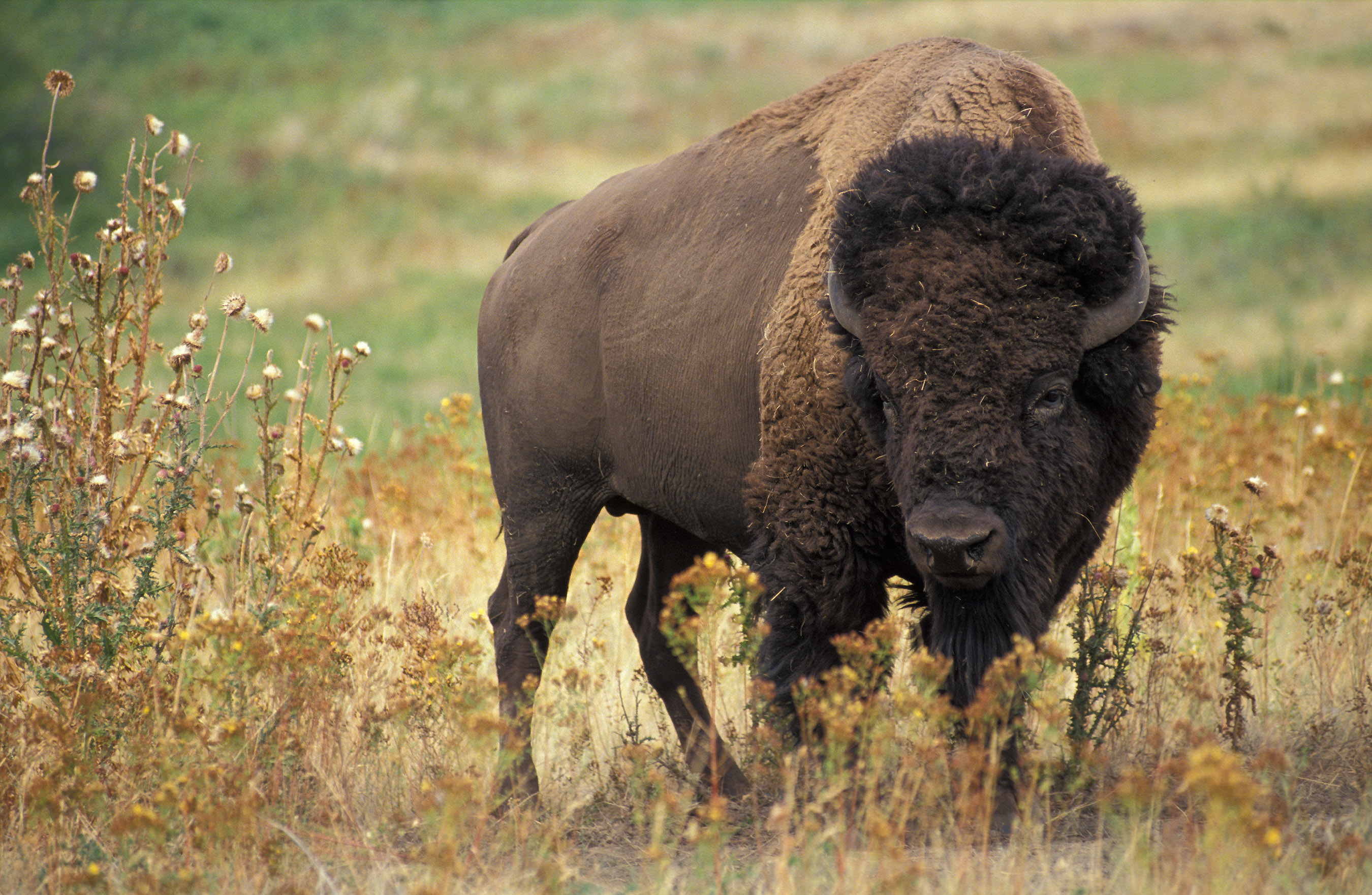
American Bison (Bison bison) and Water Buffalo (primarily the Asian Water Buffalo, Bubalus arnee for wild, Bubalus bubalis for domestic) are both large bovine mammals, but they belong to different genera and evolved on separate continents.

Bison are often mistakenly called “buffalo” in North America, but true buffalo include the Water Buffalo (Asia) and Cape Buffalo (Africa).
Physical Appearance and Size
American Bison:
Build: Massive shoulder hump (muscle for head-swinging in snow/foraging), shaggy thick fur (especially on head, shoulders, and beard), low-hanging head.
Horns: Short, curved, sharp (up to ~2 ft / 60 cm long).
Size: Males (bulls) typically 1,000–2,200 lbs (up to ~2,800 lbs recorded wild; heavier in captivity). Shoulder height ~5.5–6.5 ft (up to ~6.5–6.7 ft). Head-to-rump length up to ~11.5 ft. Females smaller (~790–1,200 lbs).
Coat: Thick, woolly, dark brown—adapted for cold.
Water Buffalo (focus on wild/Asian):
Build: No prominent hump, more level back, sparser coat, wide splayed hooves for mud.
Horns: Very long, backward-curving crescent shape (can reach 5+ ft / 1.5+ m span with ridges).
Size: Wild males often 1,500–2,650 lbs (up to ~2,600+ lbs). Shoulder height ~5–6.2 ft. Head-body length ~8–10 ft + tail. Domestic varieties are generally smaller.
Coat: Gray-black, thinner—suited for hot, wet climates






Leave a Reply